09.25.2012
September 25, 2012

Japanese Graphic Design: Not in Production, a new piece of design criticism I wrote has been posted at Néojaponisme. It will be followed by six supplementary posts showing the best that Japanese contemporary graphic design has to offer.
09.17.2012
September 17, 2012
One small, subtle design change has been added to our website, but one that is huge and took a whole lot of work: ianlynam.com is now bilingual in English and Japanese.
Giant thanks to Yamane-san for plowing through miles of project translations, consulting with us on arcane typographic terms and just generally being amazing. Equally gigantic thanks to Yuki for collecting project text, editing through the sweaty summer, coordinating the whole project and making it all go smoothly. Go team!!!
宜しく!
09.09.2012
September 9, 2012

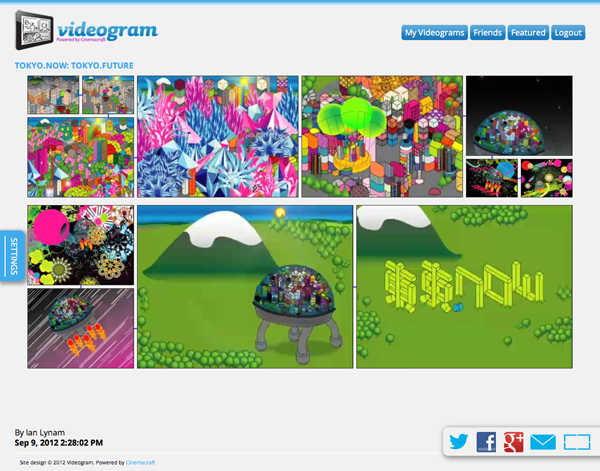
One of the most exciting projects we’ve been working on as of late is developing the identity and user interface/user experience for Videogram, a brand spanking new integrated iOS app and web app created by the amazing team at Cinemacraft.
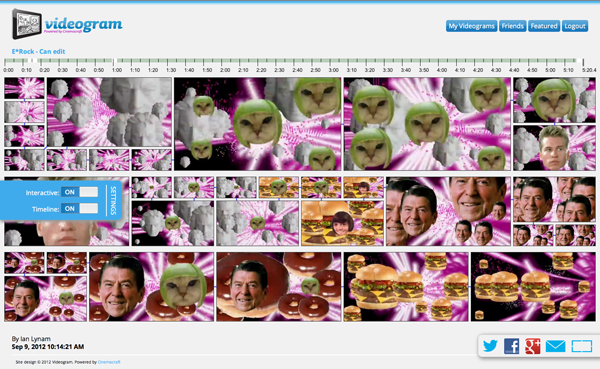
Videogram allows you to convert your personal iOS video, YouTube and Vimeo videos to interactive sequential art (comics!). Videos become sequences of still which you can click through to view video.

Revolutionary stuff, debuting this weekend at TechCrunch in San Francisco!
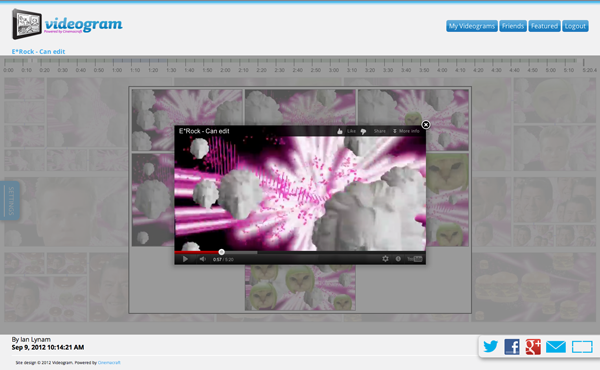
Working on Videogram has been an amazing iterative process – nothing is written in stone and everything is up for grabs!
10.08.2012
September 8, 2012

I will be lecturing on October 17 and doing a workshop on October 19 at the Vermont College of Fine Art for their MFA program in Graphic Design.
09.05.2012
September 5, 2012

I have a new essay up on Néojaponisme called “Candid Thoughts on the 2020 Olympic Logo”.
09.04.2012
September 4, 2012

Korea! I’m going to be lecturing on September 25 at Hongik University and on September 26 at Kookmin University, both in Seoul. More info soon!
Slanted #19
September 2, 2012

I contributed a 14-page standalone section to the latest issue of Germany’s Slanted magazine called Japanese Graphic Design: Not In Production. This feature stands as a critical response the current graphic design retrospective of the past ten years Graphic Design: Now In Production, Zombie Modernism 2.0 and my desire for ambiguity and contradiction in graphic design, not simplistic formula-based design.

Included is the title essay reflecting on the myopic focus of GD:NIP, a smaller essay called “With A Spatula In Her Hand” which appeared in a very small-run Spanish publication about the work of Experimental Jetset and a large survey of contemporary Japanese graphic design, including a wide array of imagery highlighting some of the most exciting and critical practices in Japan at present.

An excerpt:
“Methodologically, putting together a paragraph about assorted practices, projects, methodologies and visual trends is a fairly easy task. As a practicing graphic designer, I was aware of an easy ninety percent of the projects covered within the book. Sure, it takes time to write 500 short paragraphs about 500 subjects, but all within are easy targets. What is truly lacking in the book and exhibition is a sense of scope: Graphic Design: Now in Production represents a North American/Western European worldview toward graphic design that eschews the labors of much of the world. Notably absent is much mention of recent graphic design activity in Africa, Asia and the South Pacific. With short-format writing the dominant trend at the present moment, solid strategic thinking should be present in initiatives to represent any holistic approach to an area of cultural production. Sure, the writing can be short and pithy, but it should be far-reaching in the material covered.”

“If observed on a macro-level certain countries get the short end of the stick. Korea – for one – is wholly unrepresented in the catalog. Ahn Sang-Soo, the most influential graphic designer in that country whose work has revolutionized and energized graphic design as an area of intensified interest, receives no mention. Younger, well-known Korean graphic designers whom have studied abroad such as Sulki and Min Choi also receive no mention, despite helping to define a very defined and widely-published aesthetic and methodological approach. Less well-know, but equally influential and highly participatory projects such as Ondol/A Few Warm Stones are also ignored. In essence, the message being sent is, ‘Thanks, Korea. We’ll gladly take your study abroad students, but we’ll be damned if we’ll acknowledge any contributions from your country'”.

“Also lacking are contributions from so many other countries – the effect of easily available software and computing on Ethiopian and Eritrean music packaging, the Thai signage landscape, branding in Singapore and innumerable others. New Zealand gets a random single hit through the work of David Bennewith’s monograph on Joseph Churchward, but nowhere is Kris Sowersby, New Zealand’s leading type designer mentioned. Japan, the country in which I reside, gets a mention in the catalog, though one that is fleeting and not wholly correct…”
09.20.2012
September 2, 2012

I contributed a 14-page standalone section to the latest issue of Germany’s Slanted magazine called Japanese Graphic Design: Not In Production. This feature stands as a critical response the current graphic design retrospective of the past ten years Graphic Design: Now In Production, Zombie Modernism 2.0 and my desire for ambiguity and contradiction in graphic design, not simplistic formula-based design.
Rain Clothing Co.
September 2, 2012
Identity for Rain Clothing Co., a Canadian apparel brand.
08.24.2012
August 24, 2012

We have a couple of awesome new clients – notably the Washington County Museum…

and the National Aeronautics and Space Administration (NASA)!