02.23.2013
February 23, 2013
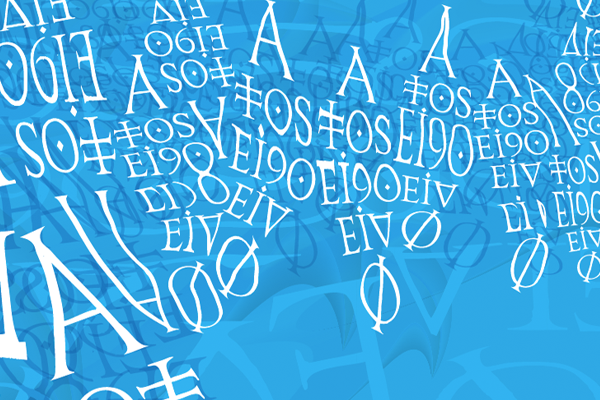
I contributed to Karen To’s Dead Words project recently. I was asked to typographically illustrate the term “ebaptization” – a retired word declaring that someone has not been properly baptized from 1659.
Within, I used Queen Mary’s secret cipher to spell out the word – the language of a woman who changed a church, and in a sense, both de- and un-baptize it.
A dead word rendered in a dead language.

We released a new typeface this week – SketchCaslon Italic – a hand-rendered display typeface with its formal base in the structure of the types of William Caslon.
One can obtain SketchCaslon Italic from MyFonts and YouWorkForThem.
Understanding Cancer Genomics
February 17, 2013
Understanding Cancer Genomics through Information Visualization is an international symposium at the University of Tokyo focusing on how information visualization approaches, methods and tools can be used in the understanding of cancer genomic data. We designed a three-color poster, three-color postcard and provided art direction for the symposium website.
Upswell 3.0
February 16, 2013

Brand spanking new website for Upswell, one of our absolute favorite clients period. The site is a database-driven overview of the work and folks that make up this amazing up-and-coming Portland design management firm.
We were involved in every stage of the site’s development and design, pitching in on editing text, clarifying design direction, tweaking imagery and hand-coding it all from scratch. The site utilizes webfonts, some snazzy custom CSS action, some rather detailed Javascript interactivity, Google Map theme customization, embedded video, image galleries and a whole lot more.
This is the third iteration of their website that we have done over the past few years and it just keeps getting better and better!
See it here.
02.02.2013
February 1, 2013

I found some unused/underused logos I designed for Tokyo hiphop duo Hifana lurking in the crates yesterday – here, a decorative, imperial take on Henk Krijger’s Raffia.

A Thai ornament-inflected logo using a Charles Burns shading treatment.

An unused logo variation for Hifana’s “Connect” LP – the best of the bunch.

On the Risograph
January 12, 2013
I wrote this brief essay for an impromptu exhibition I had at VCFA of assorted posters I’ve made over the past few years in 2012.

Life is not tidy. Every individual is constrained by the expected hours of their day that comprise their life. If you are interested in writing, you must make the time to write. If you seek to do engaging design projects outside of commercial or cultural practice, you must make the time to cultivate that practice.
Since 2009, I have made it a point to create one poster every 90 days, print 1000 copies to 5000 copies, and distribute them freely throughout Tokyo. These posters, constrained to A3 – an industrial format comparable to 11″ X 17″ in the United States (an odd and idiosyncratic format that does not fit with the International Standards Organization’s proscribed international paper size formats) – have been created outside of the boundaries of typical practice.
They are design without clients. A URL and series number are included for cataloging purposes, not for promotion. The series has included a widespread attempt at sampling the vernacular of Japanese commercial art, ranging from outright theft and re-assemblage of imagery to mimicry of indigenous forms of Japanese modern design to cultural critiques, herein represented in the narrow range of spiritual beliefs of cult-like belief systems that have been widespread throughout Japan.
This is a very limited sampling of what has been created over the past five years. They are here for you to take freely and use as you will.
Graphic Design has experienced an insurgence of the popularization of dated reprographic technology, notably the Risograph, a relatively small-scale printing system that utilizes stencil-based printing in lieu of more common photocopier technology.
The Risograph is a Japanese product manufactured by the Riso Kagaku Corporation, yet whose aesthetic has been co-opted and popularized within Graphic Design culture by establishments in Great Britain and Germany but whose usage is most prevalent within community centers and senior citizens centers within Japan.
How we print has a history. It has a heritage. It is an unacknowledged heritage. It is an unexplored heritage. In essence, it is a colonial heritage in the post-colonial age – taking from other cultures and acknowledging little beyond a footnote or a colophon.
Aesthetics always have an origin.
01.11.2013
January 11, 2013

A collaboration with Klein Dytham architecture. Ian Lynam Design created the interior graphic design scheme for Google’s new floor of offices in Roppongi.

Hundreds of meters of custom wallpapers with bespoke graphics were designed that crossed six complementary graphic themes:
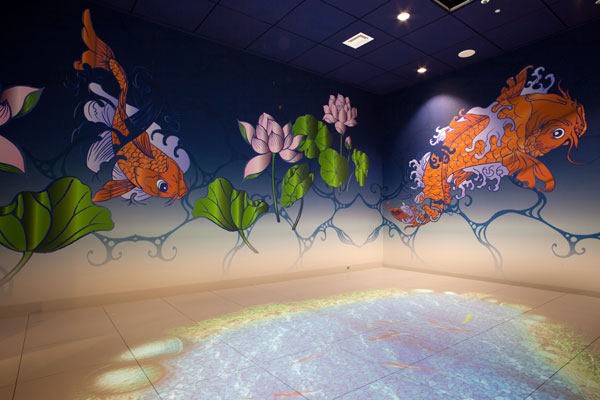
• a stylized koi pond for the office entrance

• an abstracted, hyper-pop alternate Tokyo for meeting rooms

• garden brickwork with emphasized decorative elements revealing the hidden gardens of Tokyo for hallways and common areas

• sedate gardens for the relaxation and wellness area

• a modular Tokyo for the technical services area
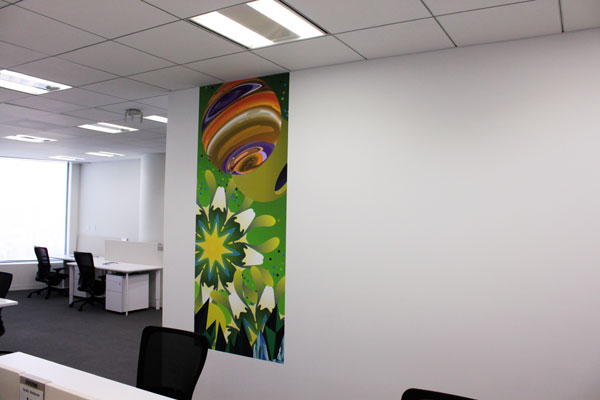
• windows into the Tokyo of the future created in a psychedelic take on 60s and 70s science fiction book covers
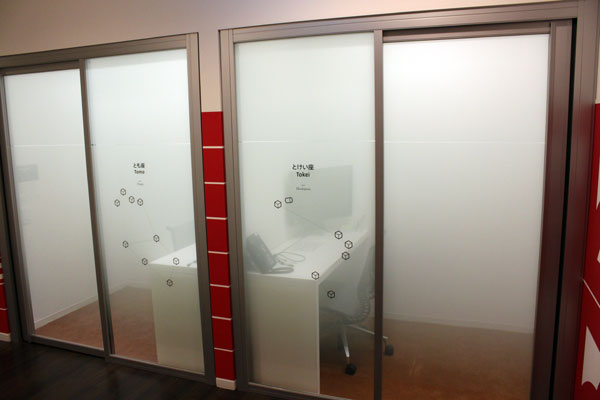
We also designed a trilingual room signage system using an alternate, but complementary graphic language.

Thanks to everyone at KDa and Google for making it such a terrific finished project!
All photos © Koichi Torimura & Toshiki Senoue.
Read more about it in the new “Spaces + Places” section of our website, along with another recent project for Google.
Doodle 4 Google
January 11, 2013

Doodle 4 Google is a contest where Google invites students in Japan to use their artistic talents to think big and to redesign Google’s homepage logo for millions to see. We created the full experience for Google’s Doodle 4 Google event in Tokyo in 2012. The project included set design, stage design, animations, lighting design, print design and sound design.
We also designed the after-party, which included activities such as a suite of computers running Google Jam attached to tactile interfaces. We used the Makey Makey system to turn pieces of Play-Doh into a guitar, the floor into a piano and pencil drawings into a drum kit. Less high-tech activities, such as doodling on the windows to build “the Tokyo of the future”, cookie decorating and playing with multiple Google-themed yoga balls rounded out the event.
NWFC Japanese Currents
January 10, 2013
Poster for Portland’s NW Film Center‘s Japanese Currents film program.